

Beatrice Bugos - "Fossil and Modern Tropical Dry Forest Response to Disturbance in Elevated Global Temperatures"
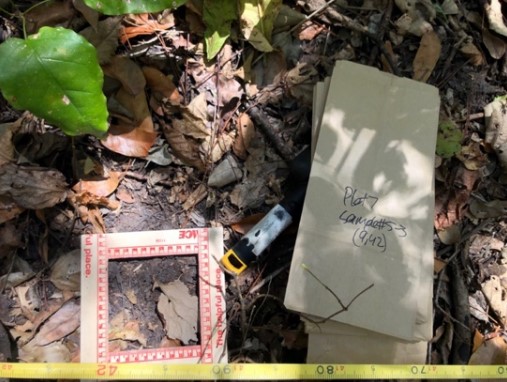
With the support of the BI Research Enhancement Grant, I have the funds to visit an international collaborator to advance my method development. These methods are novel to the paleobotany community and will provide valuable framework for conducting modern to fossil proxy work in the future. The resulting data will contribute to our understanding of the biodiversity of tropical dry forests and early Eocene Wyoming fossil forests. My research is focused on identifying the recovery stage of a fossil forest after a disturbance to understand how forests may respond in similar elevated global temperatures in the future. I’m building a dataset that maps the changes plant traits across a disturbance gradient in a modern comparison forest to identify the recovery stage in Wyoming’s early Eocene fossil forests. Currently, I’m working on observing patterns in stomata, pores on the leaf’s surface used for gas exchange, collected from leaf fragments found in the modern comparison soils to gain insight on the growth rates of plants in plots of different recovery stages. The results from the stomata patterns will both show biodiversity changes within this modern tropical dry forest and determine if this plant trait can be used to identify recovery stage in Wyoming’s fossil forests.
Beatrice Bugos
2026 Recipient of the Biodiversity Institute Graduate Student Excellence Grant
Geology & GeophysicsGeology & Geophysics
Graduate Advisor: Ellen Currano
Background:
Global warming drives extreme weather events that greatly disturb modern forests, such as devastating floods and fires. If fossil fuel burning continues unabated, by 2140, >50% of Earth’s surface will warm to reach conditions present during the Early Eocene Climatic Optimum (EECO, 51–53 Ma), an interval of a hot, equitable, and ice-free climate (Burke et al., 2018). To study the EECO and make predictions about the future, we must start with understanding the biodiversity of the modern analog forest to establish plant response to disturbance. Global warming drives extreme weather events that greatly disturb modern forests, such as devastating floods and fires. If fossil fuel burning continues unabated, by 2140, >50% of Earth’s surface will warm to reach conditions present during the Early Eocene Climatic Optimum
(EECO, 51–53 Ma), an interval of a hot, equitable, and ice-free climate (Burke et al., 2018). To study the EECO and make predictions about the future, we must start with understanding the biodiversity of the modern analog forest to establish plant response to disturbance.
The effects of disturbance on plant functional traits are well studied in modern literature and are shown to change through stages of forest recovery. Early recovery species live in stressful conditions with high photosynthetic rates, high growth rates, and long lifespans (Bazzaz 1979). Late recovery species live in low stress conditions with generally low photosynthetic rates, low growth rates, and long lifespans (Bazzaz 1979). In terms of plant physiology, stomatal conductance, a leaf’s rate of gas exchange controlled by structures on the leaf surface, is strongly correlated with photosynthesis rate and therefore recovery stage. Early recovery species have high stomatal conductance and fast photosynthetic rate, while late recovery species have low stomatal conductance and slow photosynthetic rate (Bazzaz 1979). My research will calculate maximum theoretical stomatal conductance (gmax), which assumes that all stomata, leaf pore structures, are open to their maximum dimensions (Franks & Beerling 2009). The gmax is
calculated from the stomata size and density which must be measured from unpigmented and carefully removed leaf cuticles.The effects of disturbance on plant functional traits are well studied in modern literature and are shown to change through stages of forest recovery. Early recovery species live in stressful conditions with high photosynthetic rates, high growth rates, and long lifespans (Bazzaz 1979).
Late recovery species live in low stress conditions with generally low photosynthetic rates, low growth rates, and long lifespans (Bazzaz 1979). In terms of plant physiology, stomatal conductance, a leaf’s rate of gas exchange controlled by structures on the leaf surface, is strongly correlated with photosynthesis rate and therefore recovery stage. Early recovery species have high stomatal conductance and fast photosynthetic rate, while late recovery species have low stomatal conductance and slow photosynthetic rate (Bazzaz 1979). My research will calculate maximum theoretical stomatal conductance (gmax), which assumes that all stomata, leaf pore structures, are open to their maximum dimensions (Franks & Beerling 2009). The gmax is calculated from the stomata size and density which must be measured from unpigmented and carefully removed leaf cuticles.
I will study leaf cuticle, the decay resistant outer layer of a leaf, from Parque Nacional Santa Rosa (PNSR), Costa Rica, as my modern analog forest for the Wyoming EECO fossil record. The Wyoming EECO plant fossil sites are categorized as subtropical or tropical dry forest, making PNSR a good modern analog (Wilf, 2000). My results will establish a modern record of variation in stomatal conductance along a disturbance gradient in a tropical dry forest, which is directly comparable to the Wyoming EECO fossil record and contributes to our understanding of the diversity of plant traits in PNSR. I will study leaf cuticle, the decay resistant outer layer of a leaf, from Parque Nacional Santa Rosa (PNSR), Costa Rica, as my modern analog forest for the Wyoming EECO fossil record. The Wyoming EECO plant fossil sites are categorized as subtropical or tropical dry forest, making PNSR a good modern analog (Wilf, 2000). My results will establish a modern record of variation in stomatal conductance along a disturbance gradient in a tropical dry forest, which is directly comparable to the Wyoming EECO fossil record and contributes to our understanding of the diversity of plant traits in PNSR.
Share This Page
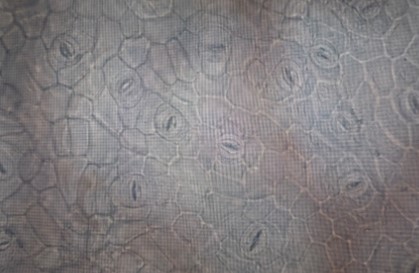
A cleared leaf cuticle showing the stomata (donut shaped with a dark hole in the center).
Research Highlights
Jun 16, 2020, 5:09 PM

May 4, 2026, 4:55 PM